




Search
Related News
- 00
0000-00
What to verify before choosing an ETFE membranes supplier - 00
0000-00
When does biaxial carbon reinforcement improve wind blade stiffness? - 00
0000-00
What to verify before choosing a dust collection systems manufacturer - 00
0000-00
When high strength geotextile fabrics are needed for steep slopes - 00
0000-00
What drives ballistic protection materials cost for body armor?
Vietnam Delays HDPE Liner Dumping Ruling




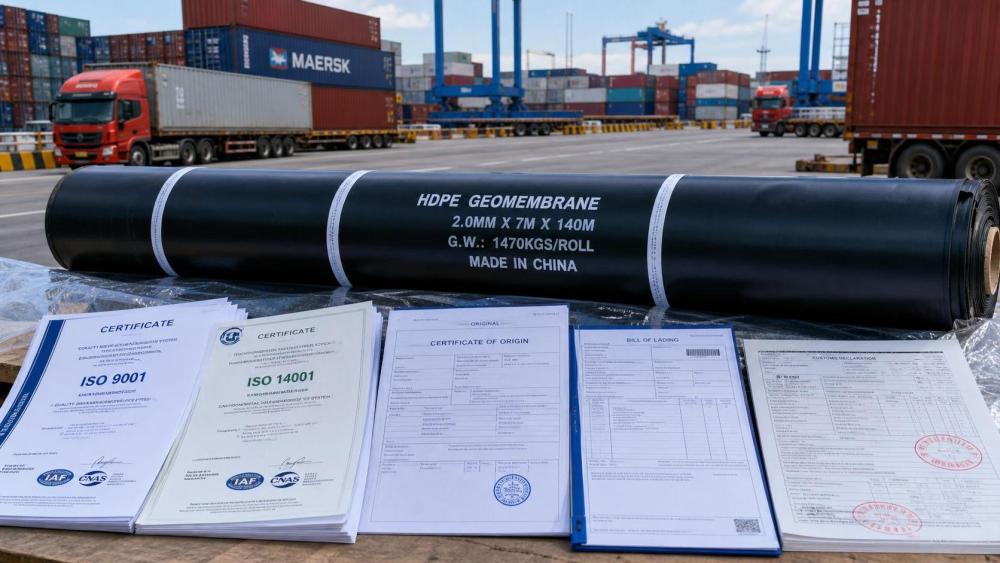
On July 7, 2026, Vietnam’s Ministry of Industry and Trade announced that the preliminary ruling date in its anti-dumping investigation into HDPE geomembranes from China has been moved from August 15, 2026 to November 15, 2026. The date change does not remove near-term trade pressure, because importers are now required to provide customs with an origin compliance declaration and copies of the Chinese factory’s ISO 9001 and ISO 14001 certificates; otherwise, customs clearance may be delayed by up to 14 working days. For exporters, importers, procurement teams, and delivery planners, the immediate issue is no longer only the investigation timeline, but also the tighter documentation gate now affecting shipment release.
The confirmed change in timeline and customs documents
According to the announced information, the preliminary ruling in Vietnam’s anti-dumping investigation concerning HDPE geomembranes from China was postponed from the originally scheduled date of August 15, 2026 to November 15, 2026.
The same notice also requires importers, effective immediately, to submit an origin compliance declaration to customs together with copies of the Chinese factory’s ISO 9001 and ISO 14001 certificates.
The announced consequence for missing documents is a customs clearance delay of up to 14 working days.
Where the pressure is likely to appear first
Export shipments facing a narrower release window
From an industry perspective, Chinese suppliers shipping HDPE geomembranes into Vietnam may feel the first impact at the delivery stage. The postponement of the preliminary ruling extends the period of uncertainty, while the added customs document requirement creates an immediate operational checkpoint. What deserves closer attention is whether shipment files are complete before cargo arrival, because document gaps can translate into slower release rather than only future policy risk.
Import and procurement teams working with tighter document control
Importers and purchasing teams are likely to be affected at order confirmation, document collection, and customs preparation. Analysis shows that the new declaration and certificate copies become part of the transaction readiness threshold. Buyers relying on short replenishment cycles or fixed project delivery dates should pay closer attention to whether origin declarations and ISO 9001 plus ISO 14001 records are available in usable form before shipment execution.
Supply chain coordinators managing handoff risk
For logistics coordinators, brokers, and supply chain service providers, the practical impact may center on file consistency and submission timing. Observably, this is not only a trade remedy timeline issue but also a customs handling issue tied to supporting compliance records. The main concern is whether documentation can move in step with cargo schedules, especially where delivery plans leave little room for a possible 14-working-day delay.
What companies should monitor now
Check whether factory certification files are current and ready to use
Analysis shows that companies involved in current or near-term shipments should first verify whether copies of ISO 9001 and ISO 14001 certificates from the Chinese manufacturing site are available, legible, and aligned with the factory named in trade documents. The announced requirement makes certificate availability a practical customs issue rather than a background qualification item.
Review origin-related paperwork before cargo movement
What deserves closer attention is the origin compliance declaration now required by customs. Because the input information does not provide the detailed filing format or review standard, companies should treat this as an active documentation checkpoint and follow subsequent official wording closely rather than assume a uniform practice has already formed.
Rework lead-time assumptions in procurement and delivery plans
Observably, the postponement of the preliminary ruling extends the observation period, but the customs requirement creates an immediate execution risk. Procurement, sales, and operations teams may need to reassess promised delivery windows, internal approval timing, and buffer days for shipments linked to Vietnam, particularly where project schedules depend on rapid customs release.
Watch for changes in transaction and bid documents
From an industry perspective, companies should also watch whether this requirement begins to appear more explicitly in purchase terms, shipment checklists, technical document requests, or bid-related qualification files. The current information does not confirm such changes, so this remains a monitoring point rather than an established market-wide outcome.
Why this reads more as an execution signal than a resolved risk event
Analysis shows that the announcement should not be read simply as a delay in procedure. The extension to November 15, 2026 lengthens the period before the preliminary ruling, but the same notice introduces an immediate customs-facing compliance requirement. It is more appropriate to understand this as a live execution signal: the formal case timeline has moved, yet the burden on documentation and shipment readiness has already tightened.
Observably, the most important near-term question is not whether the investigation risk has disappeared, because the provided information does not support that conclusion. The more relevant question is how consistently the new paperwork requirement will be applied in practice and how quickly market participants adapt their document flow.
How the market should read the current stage
At this stage, the development is best understood as a combination of continued trade uncertainty and immediate customs compliance tightening. The confirmed facts point to a longer wait for the preliminary anti-dumping decision, while also showing that shipment execution now depends more directly on origin and management-system documentation. A neutral reading is that the rule change matters most today in clearance timing, supplier readiness, and procurement planning, while the broader trade outcome still requires continued observation.
Basis of this article and what still needs verification
This article is generated from the user-provided news title, event date, and event summary. For events of this type, relevant source categories commonly include official notices, releases by regulatory or trade authorities, customs-related information, industry association updates, standard-setting documents, and reporting by established business or industry media.
No specific official source link was provided in the input, so the exact official publication path still needs to be verified on an ongoing basis. Further observation is also needed regarding any follow-up policy wording, certification enforcement approach, customs implementation practice, tender document changes, industry feedback, and how companies are handling the new documentation requirement in actual shipments.
Related News
- How to assess an HDPE geomembranes manufacturer’s weld qualitySep 09, 2026HDPE geomembranes manufacturer weld quality: learn how to assess welding methods, seam testing, operator skills, traceability, and reliable containment performance.
- How to choose geomembrane systems for mining ponds by chemical resistanceSep 07, 2026Geomembrane systems for mining ponds: learn how to match liner materials with chemical exposure, temperature, seams, and protection for reliable containment.
- When is a 1.5 mm HDPE geomembrane thick enough for a landfill liner?Sep 03, 20261.5 mm HDPE geomembranes for landfill liners: assess puncture risk, leachate chemistry, slopes, CQA, and when a thicker barrier is justified.
- When geosynthetics for separation are needed between subgrade and baseAug 22, 2026Geosynthetics for separation become essential when weak, wet, or variable subgrades threaten base contamination. Learn when to specify them to reduce failure risk, save aggregate, and protect pavement life.