




Search
Related News
- 00
0000-00
When do lightweight ETFE architectural membranes suit roof projects? - 00
0000-00
How to qualify a glass fiber rovings manufacturer for wind blade production - 00
0000-00
How to choose baghouse filters for European emission control limits - 00
0000-00
What drives body armor systems cost for NIJ-compliant protection? - 00
0000-00
What to verify before choosing an ETFE membranes supplier
Tags
Vietnam Tightens HDPE Geomembrane Import Clearance




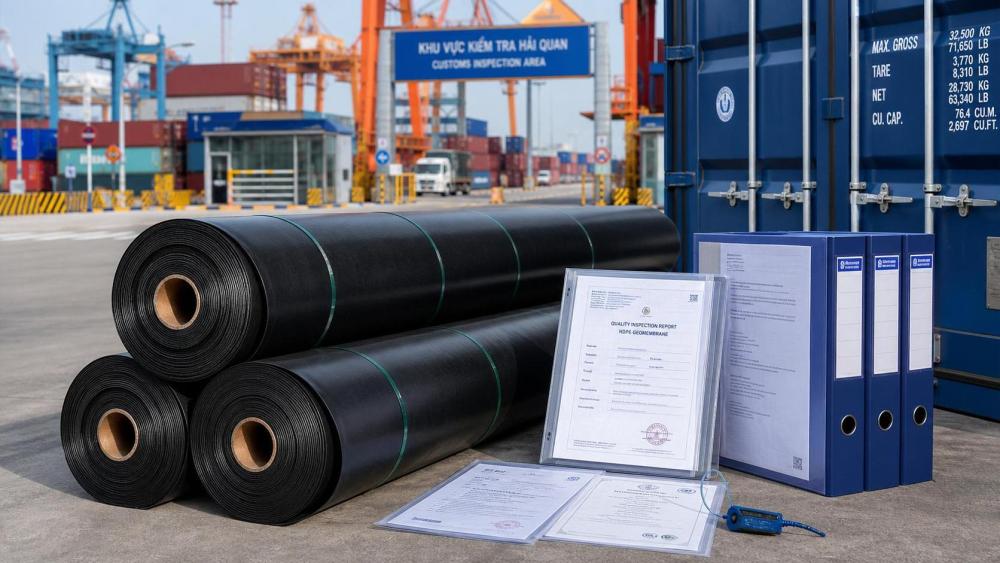
Effective from 00:01 on July 12, 2026, Vietnam’s Ministry of Industry and Trade (MOIT) has put a new documentation requirement into force for imported HDPE impermeable geomembranes. The change matters immediately to exporters, import agents, compliance teams, and buyers tied to Vietnam-bound shipments because customs clearance now depends on a dual-track certification set, and missing paperwork can materially slow delivery timing and raise transaction costs.
What the New Clearance Rule Requires
According to the provided event summary, MOIT began implementing Circular No. 18/2026/TT-BCT on July 12, 2026. For import customs declarations covering HDPE impermeable geomembranes, importers must now provide two documents at the same time: a UV degradation resistance report issued by a China CNAS-accredited laboratory under GB/T 1842-2026, and an equivalence confirmation letter reviewed and issued by a Vietnam VILAS-certified body.
The same summary states that if either document is missing, the shipment will be subject to 100% port inspection. In that case, the average customs clearance cycle extends to 14 working days. The stated direct impact is on the delivery rhythm and compliance cost of Chinese HDPE geomembrane exporters.
Where the Pressure Will Show Up First
Export transactions face a documentation timing issue
From an industry perspective, direct trading companies handling China-to-Vietnam HDPE geomembrane shipments are the first group likely to feel the change. The immediate issue is not only whether the product can be shipped, but whether the required laboratory report and the Vietnam-side equivalence confirmation can be prepared in step with booking, declaration, and handover schedules.
Manufacturers and quality teams may see added coordination work
For processing and manufacturing enterprises, the rule connects product compliance more tightly with export execution. What deserves closer attention is the handoff between production records, laboratory testing arrangements, and external certification review, because the customs requirement is tied to document completeness rather than only commercial shipment readiness.
Importers, distributors, and buyers in Vietnam face delivery uncertainty
Vietnam-based importers, channel operators, and procurement parties may be affected through delayed cargo availability when paperwork is incomplete. Observably, the risk here is concentrated in project timing, receipt planning, and downstream scheduling, especially where delivery windows are sensitive to customs release timing.
Supply chain service providers will need tighter pre-clearance checks
Customs brokers, freight forwarders, and related service providers are also exposed at the operational level. Their main concern is whether shipment files can be screened before arrival to avoid a 100% inspection outcome that lengthens the clearance cycle to the 14-working-day average noted in the event summary.
What Companies Should Watch Now
Whether both documents can be secured before declaration
Analysis shows the most practical checkpoint is document readiness before customs filing. Businesses involved in Vietnam-bound HDPE geomembrane shipments should focus on whether the CNAS laboratory report under GB/T 1842-2026 and the VILAS-side equivalence confirmation are available as a matched set, rather than treating them as separate follow-up items.
The distinction between a rule on paper and clearance in practice
What deserves closer attention is the gap that can emerge between a formal requirement and day-to-day customs handling. Even where teams understand the rule, the operational question is whether internal document review, external certification coordination, and shipment release planning have been aligned closely enough to prevent avoidable inspection delays.
Contract timing, lead time, and customer communication
For exporters and suppliers, this development puts more weight on delivery commitments and communication with counterparties. Analysis shows that where documents are incomplete, the risk is not abstract compliance exposure but a concrete extension in customs timing, which can affect promised delivery dates and order execution rhythm.
Follow-up notices and interpretation changes
Companies should also continue monitoring whether subsequent official wording, procedural clarification, or implementation interpretation changes how the requirement is handled in practice. Based on the provided information alone, the rule is already effective, but the operational pattern around review, confirmation, and inspection remains a key area for continued verification.
How This Should Be Read at This Stage
Observably, this development is more than a routine paperwork adjustment because it links product testing evidence and Vietnam-side equivalence review directly to customs efficiency. At the same time, it is more appropriate to understand this as an active compliance and execution signal rather than a basis for broad market conclusions. The confirmed facts point to tighter entry requirements and a higher penalty for missing documents, but they do not by themselves establish how uniformly the burden will fall across all participants over time.
The Immediate Industry Meaning
At this stage, the clearest takeaway is that Vietnam-bound HDPE geomembrane trade now requires closer coordination between testing, certification review, customs preparation, and delivery scheduling. The event is best understood as an immediate operational change with potential longer-term implications, not as a complete reshaping of the market. For now, the priority is disciplined document control and close observation of how the rule is applied in actual clearance workflows.
Basis of This Article and Ongoing Verification
This article is based on the user-provided news title, event date, and event summary. For this type of industry update, relevant source categories typically include official government notices, company disclosures, industry association updates, authoritative media reporting, and standards-related documents. No specific official source link was provided in the input, so the exact official link remains to be verified on an ongoing basis. The main follow-up points are whether additional official clarification appears and how the documentation requirement is implemented in real customs operations.
Related News
- How to assess an HDPE geomembranes manufacturer’s weld qualitySep 09, 2026HDPE geomembranes manufacturer weld quality: learn how to assess welding methods, seam testing, operator skills, traceability, and reliable containment performance.
- How to choose geomembrane systems for mining ponds by chemical resistanceSep 07, 2026Geomembrane systems for mining ponds: learn how to match liner materials with chemical exposure, temperature, seams, and protection for reliable containment.
- When is a 1.5 mm HDPE geomembrane thick enough for a landfill liner?Sep 03, 20261.5 mm HDPE geomembranes for landfill liners: assess puncture risk, leachate chemistry, slopes, CQA, and when a thicker barrier is justified.
- When geosynthetics for separation are needed between subgrade and baseAug 22, 2026Geosynthetics for separation become essential when weak, wet, or variable subgrades threaten base contamination. Learn when to specify them to reduce failure risk, save aggregate, and protect pavement life.