




Search
Related News
- 00
0000-00
When do hot gas filter bags need PTFE instead of PPS? - 00
0000-00
What drives the price of marine coated fabrics for inflatable boats? - 00
0000-00
When do lightweight ETFE architectural membranes suit roof projects? - 00
0000-00
How to qualify a glass fiber rovings manufacturer for wind blade production - 00
0000-00
How to choose baghouse filters for European emission control limits
Tags
Vietnam Tightens HDPE Geomembrane Import Testing




On July 12, 2026, Vietnam's Ministry of Industry and Trade (MOIT) introduced a new compliance requirement for imported HDPE impermeable geomembranes that will take effect on October 1, 2026. The change ties customs clearance to a stricter documentation package: importers must provide test reports issued by a CNAS-accredited laboratory in China and supported under the ISO/IEC 17025 international mutual recognition framework. For exporters, buyers, testing providers, and supply chain teams handling HDPE geomembrane shipments, this matters because the rule moves laboratory documentation closer to the point of customs execution and is expected to extend delivery timelines while increasing testing costs.
What the new filing requirement clearly changes
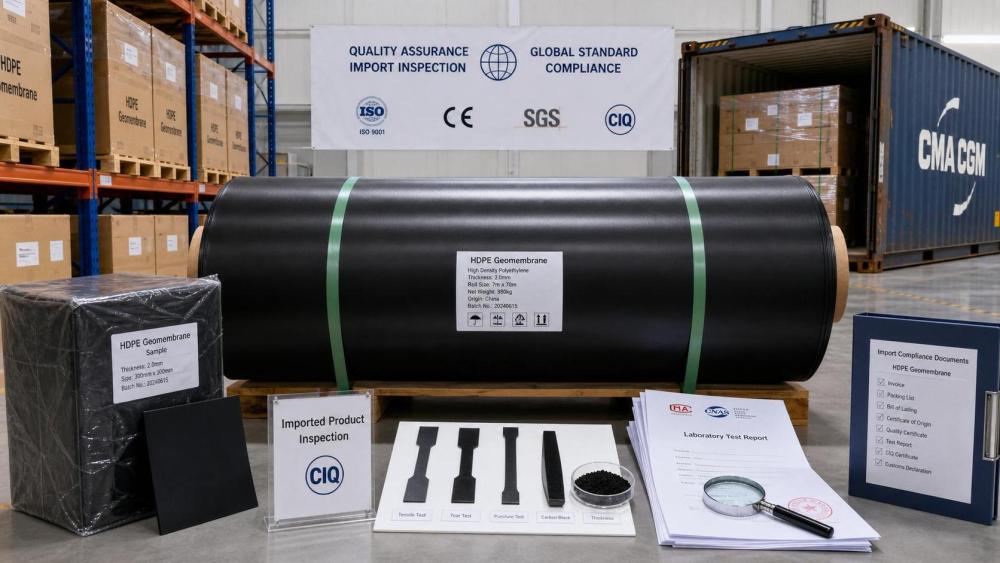
According to the provided event summary, MOIT issued Circular No. 18/2026/TT-BCT on July 12, 2026 as a supplementary notice. From October 1, 2026, all imported HDPE impermeable geomembranes must be accompanied at customs clearance by three core reports: tensile strength, carbon black content, and stress crack resistance under ASTM D5881.
The same summary states that these reports must be issued by a laboratory in China accredited by CNAS, while also carrying backing within the ISO/IEC 17025 international mutual recognition system. The reported practical consequence is a longer delivery cycle for Chinese exporters and higher testing costs.
Where the pressure is likely to appear first
Export shipment preparation becomes more document-dependent
From an industry perspective, Chinese exporters of HDPE impermeable geomembranes are the first group likely to feel the change because the customs step is now directly tied to a narrower testing-document condition. The main impact is likely to fall on pre-shipment planning, document completeness checks, and the sequencing of production, testing, and dispatch. What deserves closer attention is whether shipment schedules, internal release procedures, and customer handover documents are aligned with the three required reports and the dual-recognition condition described in the notice summary.
Import procurement teams may need earlier coordination
Buyers and procurement teams handling imports into Vietnam may also be affected because the rule is framed around customs clearance rather than only product preference or contract terms. Analysis shows that purchasing decisions may need to account earlier for laboratory qualification, report availability, and the time needed to assemble compliant documents. The immediate issue is less about changing product demand and more about reducing the risk that cargo arrives without the required supporting reports.
Testing and compliance service providers face a narrower gate
Laboratories, certification-related service firms, and compliance coordinators are also likely to see a more defined role under this requirement. The event summary points to two linked conditions: CNAS accreditation in China and backing under the ISO/IEC 17025 mutual recognition framework. Observably, that makes laboratory selection, report format review, and traceability of test documentation more sensitive parts of the transaction, especially for the three named performance items.
Logistics and delivery management may need longer buffers
Supply chain service providers, freight coordinators, and delivery planning teams are likely to be affected indirectly through timing. Since the provided information explicitly notes longer delivery cycles, the business impact may show up in cargo readiness dates, booking coordination, and customer delivery commitments. Companies involved in scheduling should therefore pay closer attention to whether testing is completed early enough to avoid customs-related disruption.
Practical checkpoints before the October effective date
Review whether current test documentation matches the new threshold
Analysis shows that companies should first compare their existing documentation practices with the October 1, 2026 requirement. The key question is whether current reports already cover tensile strength, carbon black content, and stress crack resistance under ASTM D5881, and whether they are issued under the required laboratory recognition conditions stated in the summary.
Recheck supplier and laboratory qualification paths
What deserves closer attention is the qualification path behind each report. For exporters and buyers, this means checking in advance whether the testing laboratory is CNAS-accredited in China and whether the ISO/IEC 17025 mutual recognition backing is appropriately reflected in the documentation set. The provided information does not supply execution details beyond that requirement, so this should be treated as a current compliance checkpoint rather than a confirmed procedural template.
Adjust lead-time assumptions in contracts and procurement plans
Observably, the notice is not only a paperwork issue; it may also reshape delivery timing assumptions. Since the summary explicitly states that delivery cycles will be extended and testing costs will rise, companies should review contract timing, replenishment plans, and shipment release windows with those risks in mind. This is especially relevant where delivery commitments were previously based on standard testing cycles without the added customs-document dependency.
Keep watching for execution language and market follow-through
The summary confirms the rule change and effective date, but it does not provide detailed implementation language beyond the core filing requirement. From an industry perspective, companies should continue monitoring how the requirement is reflected in customs practice, technical documents, procurement files, and customer acceptance conditions after the rule takes effect.
Why this looks like an execution signal, not just a policy headline
Analysis shows that this development is better understood as a concrete execution signal because it links import clearance to named test items and named recognition conditions with a defined effective date. At the same time, it is still not a fully closed compliance picture because the provided information does not include fuller operational detail on document format, review process, or how strictly the requirement will be interpreted in practice. That is why the market response should be measured: the rule itself is clear enough to trigger preparation, while the exact enforcement rhythm still deserves observation.
How the market should read this development now
At this stage, it is more appropriate to understand the update as a rule change with immediate planning implications for HDPE impermeable geomembrane trade into Vietnam, especially where Chinese exporters are involved. The core significance is not simply that another test requirement exists, but that customs clearance is being tied to a dual-recognition documentation standard covering three specific performance reports. The likely effect is tighter compliance screening before shipment, with lead-time and cost pressure becoming part of routine trade planning rather than an afterthought.
Basis of this article and what still needs verification
This article is based on the user-provided news title, event date, and event summary. For developments of this type, relevant source categories typically include official notices, releases from regulatory authorities, customs or trade administration information, industry association updates, standard organization documents, and reporting by authoritative trade media.
No specific official source link was provided in the input, so the original publication path and any later explanatory notices still need ongoing verification. Further observation should focus on detailed implementation language, certification and laboratory interpretation, changes in procurement or tender documentation, market feedback, and how companies execute against the new requirement after the October 1, 2026 effective date.
Related News
- How to assess an HDPE geomembranes manufacturer’s weld qualitySep 09, 2026HDPE geomembranes manufacturer weld quality: learn how to assess welding methods, seam testing, operator skills, traceability, and reliable containment performance.
- How to choose geomembrane systems for mining ponds by chemical resistanceSep 07, 2026Geomembrane systems for mining ponds: learn how to match liner materials with chemical exposure, temperature, seams, and protection for reliable containment.
- When is a 1.5 mm HDPE geomembrane thick enough for a landfill liner?Sep 03, 20261.5 mm HDPE geomembranes for landfill liners: assess puncture risk, leachate chemistry, slopes, CQA, and when a thicker barrier is justified.
- When geosynthetics for separation are needed between subgrade and baseAug 22, 2026Geosynthetics for separation become essential when weak, wet, or variable subgrades threaten base contamination. Learn when to specify them to reduce failure risk, save aggregate, and protect pavement life.