




Search
Related News
- 00
0000-00
When do hot gas filter bags need PTFE instead of PPS? - 00
0000-00
What drives the price of marine coated fabrics for inflatable boats? - 00
0000-00
When do lightweight ETFE architectural membranes suit roof projects? - 00
0000-00
How to qualify a glass fiber rovings manufacturer for wind blade production - 00
0000-00
How to choose baghouse filters for European emission control limits
Tags
Vietnam Tightens HDPE Geomembrane Import Checks




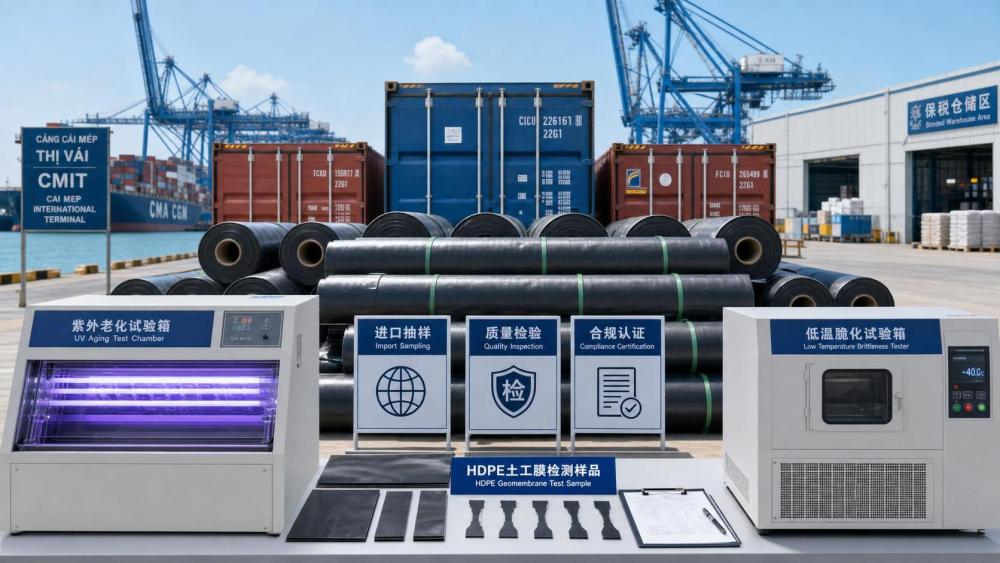
On July 12, 2026, Vietnam introduced a stricter import inspection regime for HDPE impermeable geomembranes, with joint enforcement by the Ministry of Industry and Trade and the General Department of Customs. The change matters because it adds on-site testing requirements at key ports, directly affecting exporters, buyers, logistics planning, technical documentation, and delivery reliability. For companies shipping into this market, the issue is no longer only product specification on paper, but whether each batch can withstand immediate port-level verification under the new testing approach.
What Has Changed at Port-Level Inspection
According to the information provided, from July 12, 2026, Vietnam's Ministry of Industry and Trade and General Department of Customs began applying an enhanced cargo inspection mechanism to HDPE impermeable geomembranes.
The measure is being implemented at Cai Mep in Ho Chi Minh City and at Hai Phong Port. Under this mechanism, 100% of batches are subject to on-site UV accelerated aging testing under ASTM D750-21 and low-temperature brittleness testing at -25°C.
The provided information also states that goods failing these checks will be refused warehouse entry and may trigger a supplier blacklist mechanism. The immediate stated effect is potential pressure on delivery schedules and commercial reputation for Chinese exporters.
Where the Pressure Will Appear Across the Trade Chain
Export-facing suppliers will face batch-by-batch compliance exposure
From an industry perspective, exporters of HDPE impermeable geomembranes are the first group exposed to this change because inspection now takes place on every batch at the port stage rather than remaining only a contractual or pre-shipment matter. What deserves closer attention is the risk concentration around shipment release, cargo acceptance, and supplier standing. Companies in this position should closely review whether their technical files, test records, and product specifications align with the performance points now being checked on site.
Procurement teams may need to revisit supplier screening
For importers, distributors, and project-side procurement teams, the rule change can affect sourcing decisions even before cargo moves. Analysis shows that when non-compliance can lead to refused warehousing and supplier blacklisting, buyers may place greater weight on verifiable testing capability, document readiness, and consistency between declared specification and delivered product. The practical issue is not only price or lead time, but whether supply can clear port inspection without disruption.
Logistics and delivery coordination become more sensitive
Supply chain service providers and delivery coordinators may also be affected because 100% batch testing introduces a more inspection-dependent handover process at the port. Observably, any shipment tied to a fixed installation or project timeline may face added scheduling risk if inspection outcomes delay cargo movement. This makes document accuracy, shipment sequencing, and communication between exporter, consignee, and port-side service partners more important than before.
Testing and compliance support functions may gain operational importance
For laboratories, quality teams, and compliance support providers, the development signals a stronger link between technical performance evidence and customs clearance outcomes. It is more appropriate to understand this as a shift in execution emphasis: test items such as UV accelerated aging and low-temperature brittleness are no longer only reference points in product qualification discussions, but have become central to import control for the affected product category at the specified ports.
What Companies Should Watch Immediately
Check whether technical documents match the inspected items
Analysis shows that companies should first verify whether product documentation, internal quality records, and any supporting test materials clearly correspond to the UV accelerated aging and -25°C low-temperature brittleness items now named in the inspection mechanism. Where wording, methods, or specification references are unclear, that gap may become a practical trade risk.
Review delivery commitments against the new inspection reality
What deserves closer attention is the effect on promised lead times. Because the provided information indicates 100% batch inspection at Cai Mep and Hai Phong, exporters and buyers should reassess delivery buffers, port scheduling assumptions, and contract expectations related to cargo arrival and warehouse acceptance. This should be treated as a compliance-linked delivery issue rather than a routine logistics fluctuation.
Monitor blacklist exposure and quality traceability
Observably, the blacklist mechanism raises the stakes beyond a single shipment outcome. Even without further execution details in the provided information, companies should pay attention to product traceability, batch consistency, and internal escalation procedures when any quality concern arises. The issue is not only whether one lot passes, but whether repeated failure could affect future market access and counterparty confidence.
Follow later wording from authorities and market documents
The current information confirms the existence of the enhanced inspection mechanism, but it does not provide a fuller operational interpretation. For that reason, companies should continue watching for later official wording, procurement document updates, inspection practice clarification, and changes in technical submission expectations. Until those details are clearer, some execution points remain matters for observation rather than settled procedure.
Why This Looks Like an Execution Signal, Not Just a Policy Note
Analysis shows that this development is more than a general statement of regulatory intent because it combines a start date, named ports, named test items, 100% batch coverage, and a stated consequence for failed goods. That gives the market a concrete enforcement signal. At the same time, it would be premature to treat every downstream commercial effect as fixed, because the provided information does not yet describe detailed implementation practice, appeal channels, documentation format, or how consistently the blacklist mechanism will be applied in operation.
It is more appropriate to understand this as a landed compliance change with immediate trade relevance, while still recognizing that the full execution standard may become clearer only through subsequent official clarification and market response.
How the Market May Need to Read This Change
In practical terms, this event indicates that HDPE impermeable geomembrane shipments into the specified Vietnamese ports now face a more direct connection between technical performance verification and import handling. For the industry, the significance lies in the movement of testing requirements closer to the customs and warehousing stage. A rational reading is that this is already an active compliance development, while the precise long-tail effects on procurement behavior, supplier access, and routine delivery planning still require continued observation.
Basis of This Article and What Still Needs Verification
This article is based on the user-provided news title, event date, and event summary. For events of this type, relevant source categories typically include official announcements, releases from regulatory authorities, customs or trade administration information, industry association notices, standards documentation, and reporting by established trade media.
No specific official source link was provided in the input, so the underlying official publication path still requires continued verification. What should continue to be monitored includes any detailed enforcement notice, interpretation of the testing standard application, changes in tender or procurement documents, market feedback from affected companies, and how the mechanism is implemented in actual trade operations.
Related News
- How to assess an HDPE geomembranes manufacturer’s weld qualitySep 09, 2026HDPE geomembranes manufacturer weld quality: learn how to assess welding methods, seam testing, operator skills, traceability, and reliable containment performance.
- How to choose geomembrane systems for mining ponds by chemical resistanceSep 07, 2026Geomembrane systems for mining ponds: learn how to match liner materials with chemical exposure, temperature, seams, and protection for reliable containment.
- When is a 1.5 mm HDPE geomembrane thick enough for a landfill liner?Sep 03, 20261.5 mm HDPE geomembranes for landfill liners: assess puncture risk, leachate chemistry, slopes, CQA, and when a thicker barrier is justified.
- When geosynthetics for separation are needed between subgrade and baseAug 22, 2026Geosynthetics for separation become essential when weak, wet, or variable subgrades threaten base contamination. Learn when to specify them to reduce failure risk, save aggregate, and protect pavement life.